

It’s Sunday evening. You’re slumped on the sofa after a full weekend of soft play, food shopping, and fixing that thing in the bathroom that’s been broken for three weeks. Your partner asks, “So what’s the plan for this week?” and your mind goes completely blank. You know there’s a school event on Wednesday. You think you’ve got a dentist appointment. And work? That’s a mystery you’ll solve at 7:45 AM tomorrow when you open your laptop in a mild panic.
Sound familiar? You’re not alone. Most dads I know — myself included — have spent years lurching from one week to the next, reacting to whatever lands in front of them. But here’s the thing: it doesn’t take a massive overhaul to change that. It takes about 30 minutes, once a week, and it genuinely transforms how the rest of your week feels.
This isn’t about becoming some hyper-optimised productivity robot. It’s about giving yourself a clear picture of what’s coming, so you can show up for the stuff that actually matters — and stop that low-level anxiety of constantly forgetting something.
Why Dads Specifically Need a Weekly Plan
Let me be honest: before I had kids, I could get away with winging it. A vague mental to-do list and a calendar reminder here and there was enough. But fatherhood changes the equation entirely.
You’re now juggling:
Your own work commitments — meetings, deadlines, projects.
Family logistics — school runs, clubs, playdates, appointments.
Household stuff — shopping, cooking, repairs, admin.
Your partner’s schedule — making sure you’re not both double-booked.
Your own wellbeing — exercise, hobbies, rest (remember those?).
That’s a lot of moving parts. And when none of it is written down in one place, things slip through the cracks. Not because you’re a bad dad or a disorganised person, but because no one can hold all of that in their head reliably.
A weekly planning session isn’t about control — it’s about clarity. When you know what’s coming, you make better decisions about where to spend your energy.
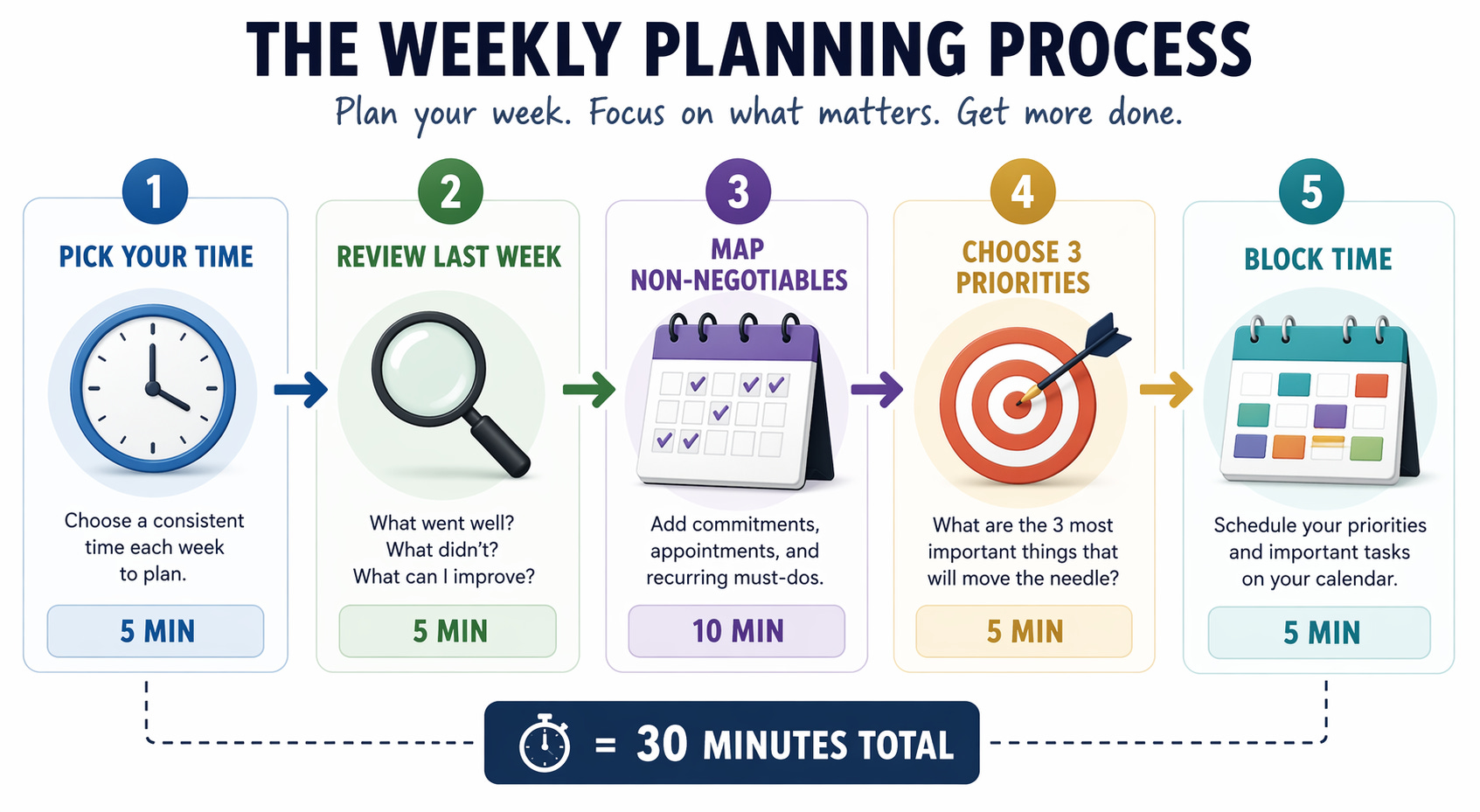
How to Set Up Your 30-Minute Weekly Planning Session
Here’s the process I use. It’s simple, flexible, and you can do it with a notebook, a phone app, or whatever works for you. The tool doesn’t matter nearly as much as the habit.
Step 1: Pick Your Time (5 Minutes to Decide, Then Stick With It)
Choose a consistent slot each week. Popular options:
Sunday evening — after the kids are in bed, before the week starts.
Friday afternoon — close out the work week and look ahead.
Saturday morning — with a coffee, before the weekend chaos kicks off.
There’s no perfect answer. The best time is the one you’ll actually stick to. I personally use Sunday evenings because it gives me a sense of calm heading into Monday.
Step 2: Review the Previous Week (5 Minutes)
Before you plan forward, glance back. Ask yourself:
What went well? Maybe you nailed that work presentation, or you made it to the gym twice. Acknowledge the wins — dads are rubbish at this.
What didn’t happen? Not to beat yourself up, but to understand why. Was it genuinely too much? Did something unexpected come up? Or did you just forget?
Is there anything unfinished that needs to carry over?
This step takes five minutes tops, and it stops you from making the same planning mistakes week after week.
Step 3: Map Out the Non-Negotiables (10 Minutes)
Open your calendar — the family one and the work one — and write down everything that’s already locked in for the coming week:
Work meetings and deadlines.
School events, kids’ clubs, and appointments.
Your partner’s commitments that affect your schedule.
Any social plans.
Now you can see the shape of your week. You’ll spot the busy days, the breathing room, and the potential clashes before they become Monday-morning surprises.
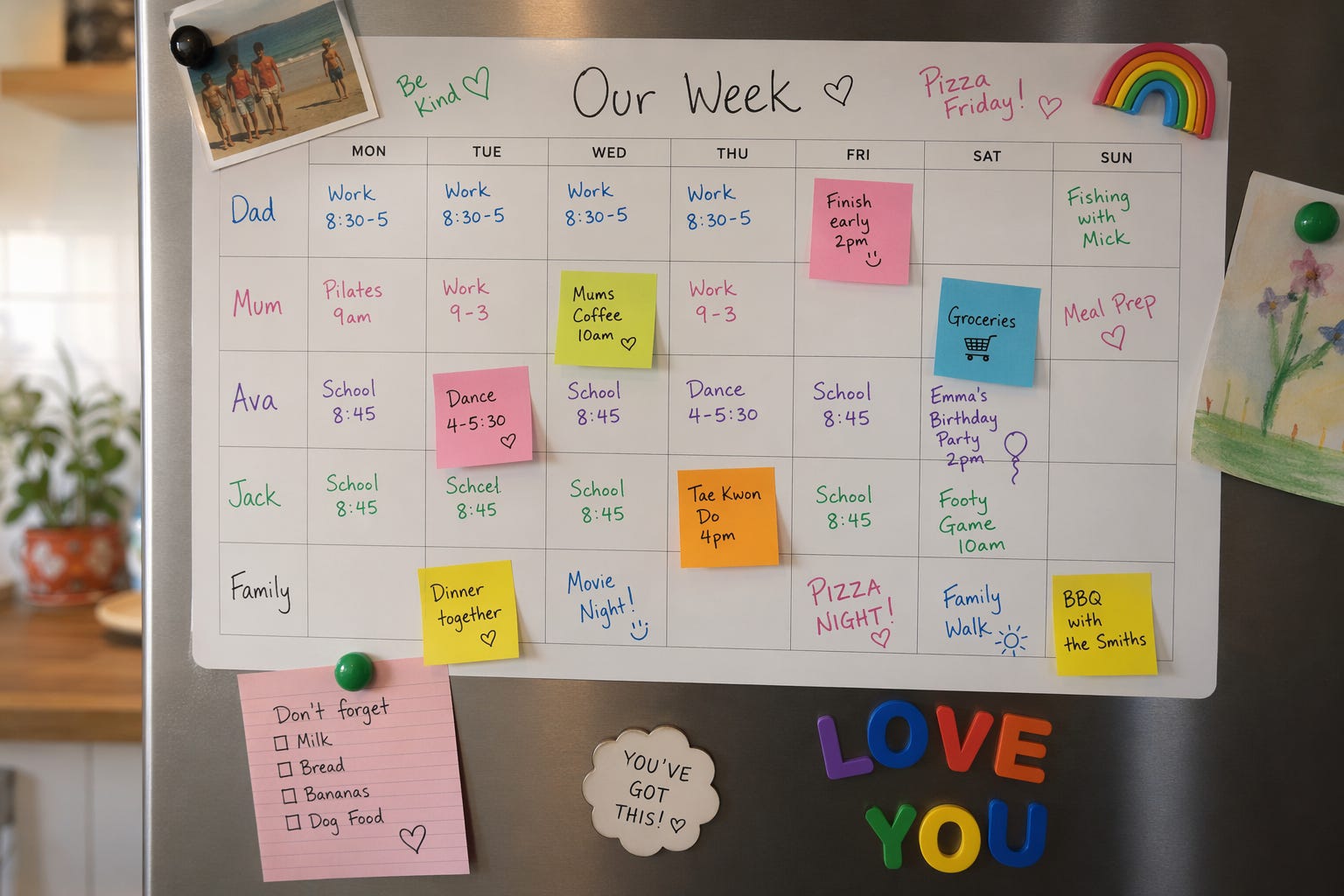
Top tip: If you and your partner don’t already share a calendar, start. It’s a game-changer. Whether it’s Google Calendar, a whiteboard in the kitchen, or an app — just get everyone’s stuff visible in one place.
Step 4: Choose Your Priorities (5 Minutes)
This is the most important step, and where most planning systems overcomplicate things. You don’t need to schedule every hour. You need to answer one question:
What are the 3 things that would make this week a success?
Not 10 things. Not a massive list. Three. They might be:
Finish the quarterly report at work.
Take the kids to the park on Saturday.
Go for a run on Tuesday and Thursday.
Write them down. These are your anchors for the week. Everything else is secondary.
“The key is not to prioritise what’s on your schedule, but to schedule your priorities.” — Stephen Covey
Step 5: Block Time for What Matters (5 Minutes)
Now take those three priorities and find specific slots in your week for them. Don’t leave them floating as “I’ll try to fit that in.” Give them a home:
The quarterly report — block out Tuesday morning, 9-11 AM, no meetings.
Park with the kids — Saturday, 10 AM. Put it in the calendar like you would a work meeting.
Running — Tuesday 6:30 AM, Thursday 6:30 AM. Kit ready the night before.
Treating personal and family priorities with the same seriousness as work meetings is the single biggest shift most dads can make. If it’s not in the calendar, it’s a wish, not a plan.
What to Do When the Plan Falls Apart
Let’s be real: you will have weeks where everything goes sideways. A kid gets ill. A work crisis lands. The boiler breaks. Life with children is unpredictable by nature.
The point of the plan isn’t that it’s perfect — it’s that it gives you a starting point to adapt from. When things go wrong, you can look at your three priorities and ask:
Can I still do one or two of these?
Can I move something to later in the week?
Do I need to let something go entirely this week? (And that’s okay.)
A plan you adjust is infinitely better than no plan at all. Don’t aim for a perfect week. Aim for an intentional one.
Making It a Shared Habit
One thing that’s made a huge difference for me is doing a quick planning check-in with my partner. It doesn’t need to be formal — just five minutes over a cup of tea:
“Here’s what I’ve got on this week.”
“Here’s what you’ve got on.”
“Where do we need to cover for each other?”
This catches the clashes (”Wait, we’ve both got something on Thursday evening — who’s with the kids?”) and means you’re working as a team rather than two people independently trying to figure it out.
Some families do this as a proper “family meeting” with older kids involved too — letting them know what’s happening in the week, asking if they need anything. It’s a brilliant way to teach kids about planning and responsibility, and it cuts down on the “But you never told me!” complaints.
Tools That Help (Without Overcomplicating Things)
You genuinely don’t need much. Here are a few options, from simple to slightly more structured:
A notebook and pen — write your three priorities and your week’s shape on a single page. Old school, but it works.
A shared digital calendar — Google Calendar, Apple Calendar, or Outlook. The key feature is sharing, so your partner sees your stuff and you see theirs.
A task management app — if you like having your to-do list alongside your calendar. Apps like Do Everything let you set weekly tasks, tag them by area of life, and carry unfinished tasks forward automatically — handy when you’re juggling family and work lists.
A whiteboard or planner on the fridge — great for families with kids old enough to read. Everyone can see the week at a glance.
The best system is the one you’ll actually use. Don’t spend three hours setting up a colour-coded Notion template if you know you’ll abandon it by Wednesday. Start simple. Add complexity only if you need it.
The Surprising Side Effects
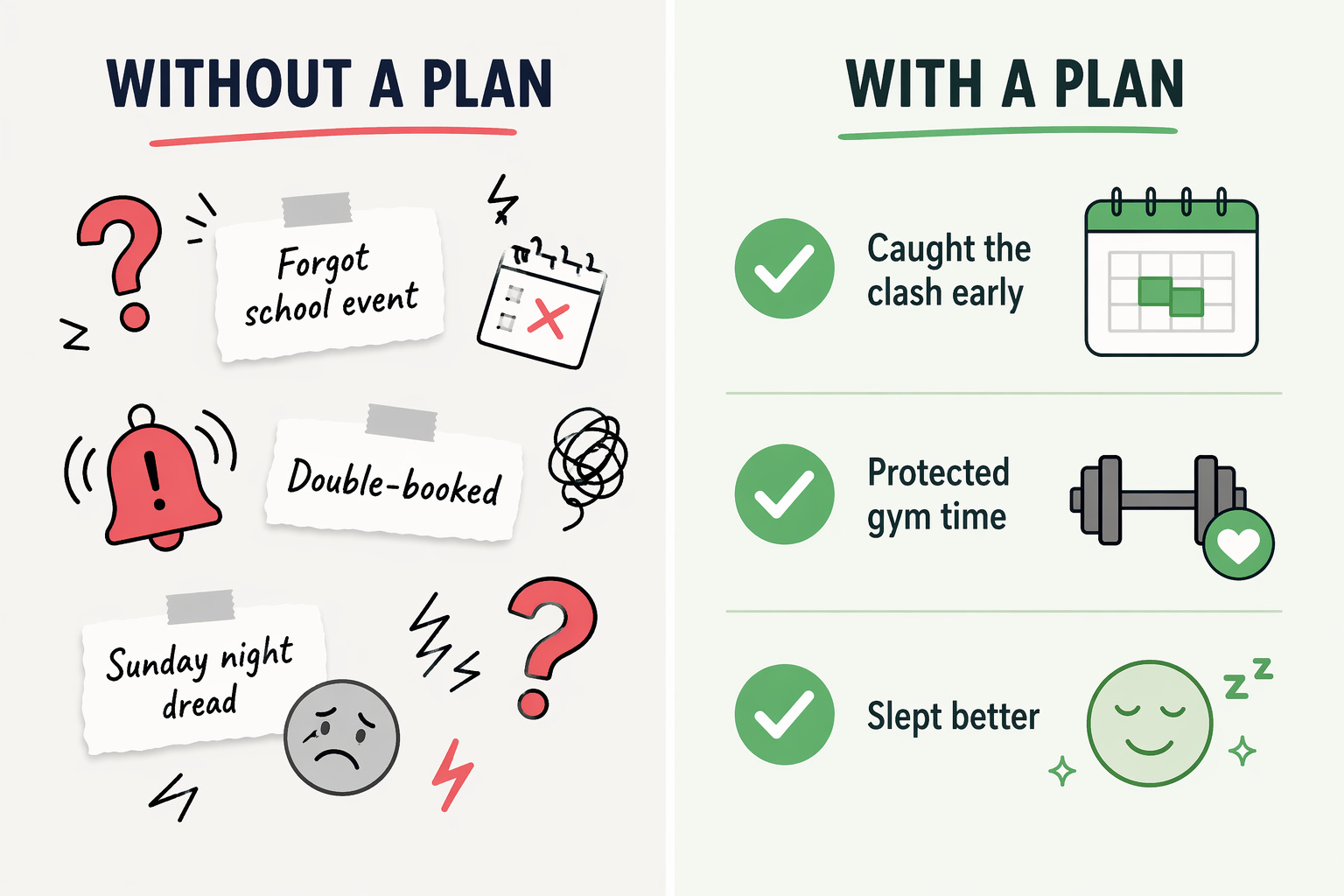
Here’s what I didn’t expect when I started weekly planning: it wasn’t just about getting more done. It changed how I felt about my weeks.
Less guilt. When you’ve deliberately chosen your priorities, you’re not constantly feeling like you should be doing something else. You made a decision. You’re following through.
More presence. When you know the work stuff is handled (or at least planned for), you can actually be there when you’re playing with your kids, instead of mentally running through your to-do list.
Better sleep. That Sunday-night dread? It fades when you already know what Monday looks like.
Fewer arguments. When both parents know the plan, there are fewer “I thought you were doing that” moments.
Research backs this up too. Studies consistently show that people who plan their weeks experience lower stress and higher feelings of control — and as dads, feeling like you’ve got a handle on things is half the battle.
Start Small This Week
If this all sounds like a lot, here’s your bare minimum. Do just this on Sunday evening:
Look at your calendar for the week ahead. Just look at it. Know what’s coming.
Write down three priorities for the week — one work, one family, one personal.
Tell your partner your plan. A two-minute conversation. That’s it.
That’s your version 1.0. It’ll take 10 minutes, and I promise you’ll feel more in control heading into Monday than you have in months. You can refine and expand from there over the coming weeks.
The goal isn’t to plan a perfect week. It’s to stop sleepwalking through one.
What does your weekly planning look like right now — do you have a system, or are you winging it? I’d love to hear what works (and what doesn’t) in the comments below.
If you enjoyed this, you might also like:
How to Juggle Work, Family, and Personal Time Without Dropping the Ball — for more on balancing all the competing demands.
The Dad’s Guide to Morning Routines — to pair your weekly plan with a solid daily start.