
How to Focus With Kids at Home: A Dad's Guide to Getting Real Work Done
Struggling to focus with kids at home? Practical, guilt-free strategies for dads who need deep work time — no locked bathroom doors required.

It’s 10:15 AM on a Tuesday. You’re fifteen minutes into what was supposed to be a focused work session. Your laptop is open, your coffee is still warm, and you’ve almost — almost — got your head around that tricky problem at work. Then it comes: “Daaaaaad! She took my crayon!”
You take a breath. You handle the crayon dispute. You sit back down, re-read the last paragraph you wrote, and try to pick up the thread. Two minutes later: “Dad, I’m hungry.” And just like that, your deep work window evaporates.
If you’re a dad working from home — whether that’s full-time remote, hybrid, or grabbing time on a day off — you already know the challenge. The question isn’t whether you’ll be interrupted. It’s whether you can get anything meaningful done despite the interruptions.
It’s Not About Eliminating the Chaos — It’s About Working With It
Here’s the uncomfortable truth most productivity advice ignores: if you’ve got young kids at home, you’re never going to have a perfectly quiet, distraction-free work environment. And chasing that ideal will only leave you frustrated.
The good news? You don’t need three uninterrupted hours to do great work. Research on deep work — the kind of focused, cognitively demanding work that actually moves the needle — shows that even 60–90 minute blocks can be incredibly productive. For parents, even shorter bursts of 25–45 minutes can be enough, if you’re intentional about how you use them.
The shift isn’t about finding more time. It’s about designing your day around the reality of life with kids — and being strategic about the time you do have.
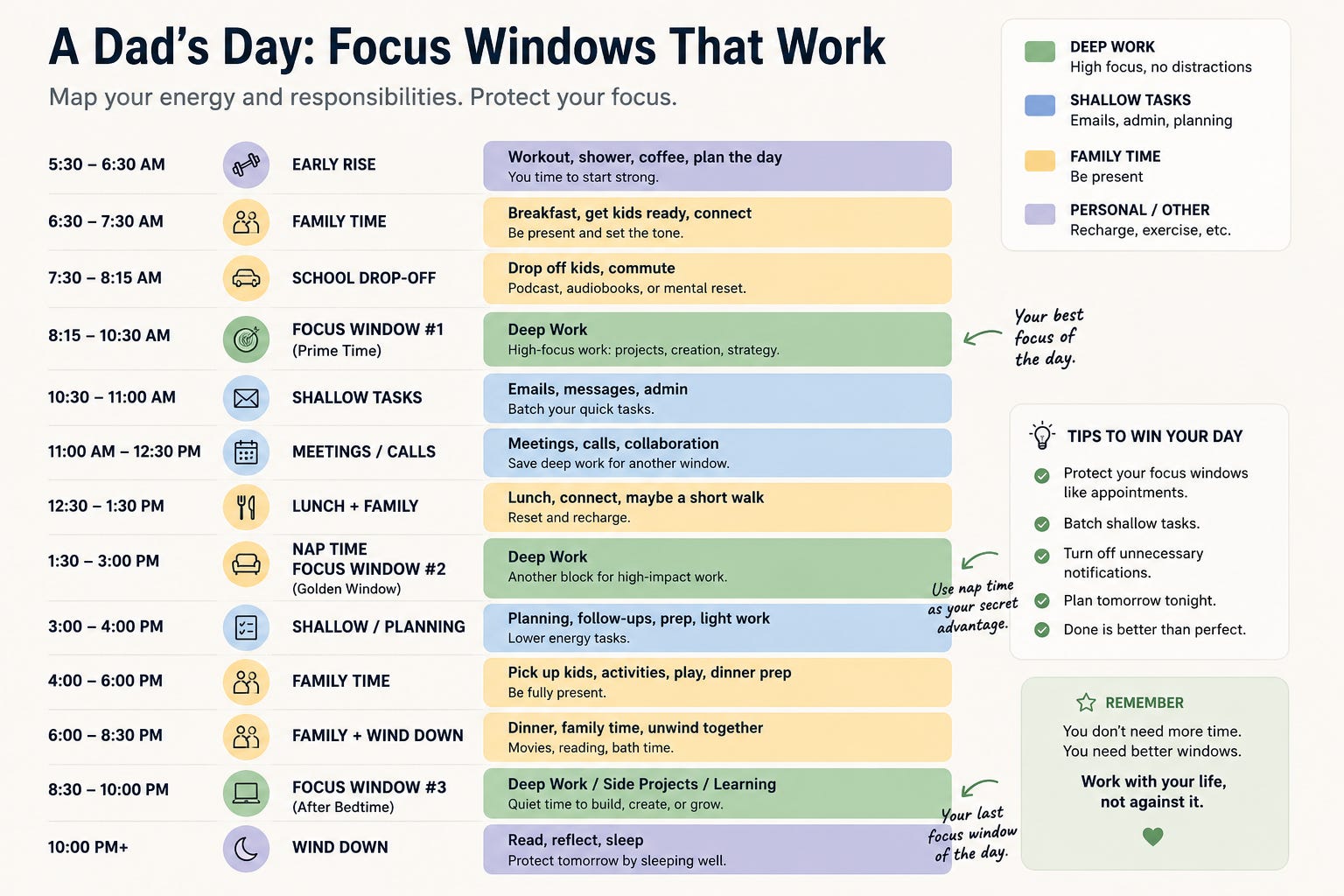
Map Your Focus Windows
Every household has a rhythm. Kids nap at roughly the same time. CBeebies runs for a predictable stretch. The school run creates a pocket of quiet. Your partner might be home on certain afternoons.
Your first job is to map these natural windows of opportunity.
Grab a piece of paper and sketch out a typical day. Mark:
When kids are asleep or at school/nursery
When another adult is home and can take the lead
When kids are most likely to play independently
When the house is genuinely at its quietest
These are your focus windows. They might be shorter than you’d like — 45 minutes here, an hour there — but they exist. The key is to protect them fiercely and use them for your most important work.
Don’t waste a focus window on emails or admin. Save those for the noisy times when you can’t think straight anyway.
Create a “Dad’s Working” Signal
Young kids don’t understand “I need to concentrate.” But they can learn visual cues.
Some ideas that work:
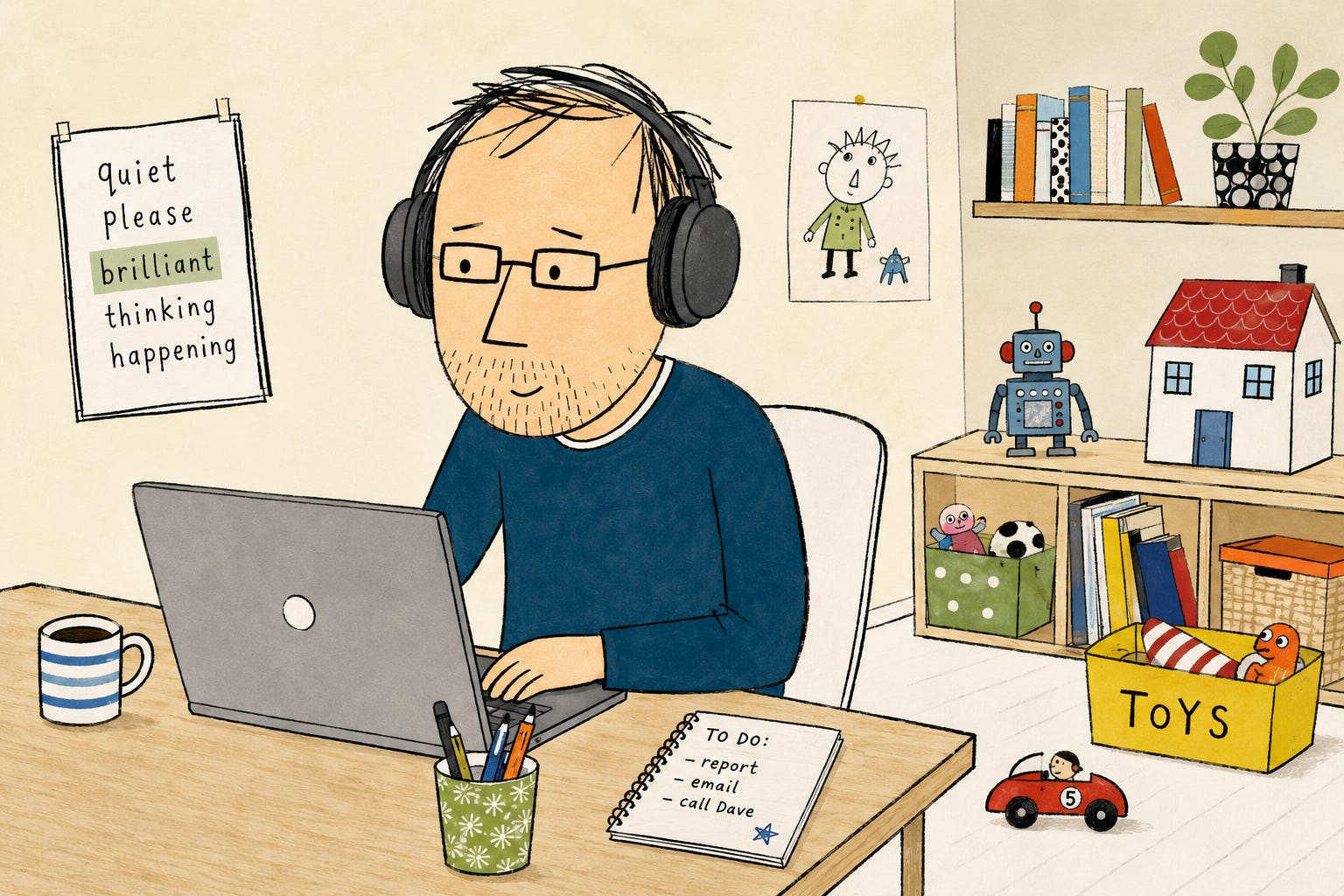
Headphones on = Dad’s working. When the headphones come off, Dad’s available. Simple, visual, effective.
A physical sign on your desk or door. Some dads use a simple traffic light system: green means “come chat,” red means “give me a few minutes.”
A timer they can see. A visual timer (like a Time Timer) shows kids exactly how long they need to wait. “When the red is gone, Dad’s finished.”
The magic here is consistency. If you sometimes respond to interruptions during “red light” time and sometimes don’t, the signal becomes meaningless. Be kind about it, but be consistent.
And make the “off” signal just as clear. When you’re done with a focus block, be fully present. Put the laptop away, get on the floor, play a game. Kids who feel secure that Dad will be available soon are far more patient about waiting.
Batch Your Deep Work
Not all work requires the same level of concentration. The trick is to match your task type to your environment.
Deep work (requires focus)
Writing, coding, problem-solving, strategic planning
Schedule during your mapped focus windows
Aim for 25–45 minute blocks with short breaks
Shallow work (can handle interruptions)
Email, Slack messages, admin, scheduling
Do these when kids are around and interruptions are likely
Keep a running list so you don’t have to think about what to do next
Micro-tasks (2–5 minutes)
Quick replies, small approvals, updating a to-do list
Perfect for the gaps between “Dad, watch this!” moments
The biggest mistake dads make is trying to do deep work during shallow-work time. You end up frustrated, half-present for both work and family, and nothing gets done properly.
Pre-Load Kids’ Activities
Here’s a game-changer that many dads overlook: set your kids up for independent play before you start your focus block, not after they come asking for something.
Five minutes of prep can buy you 30–45 minutes of uninterrupted work:
Activity boxes. Prepare a few boxes with different activities (colouring, LEGO, stickers, puzzles). Rotate them so they feel fresh.
Audio stories or podcasts. A kids’ podcast or audiobook can captivate kids for a good stretch — and it’s not screen time. Toniebox is a great product for this that I’ve found to be particularly helpful.
Simple snacks. A bowl of chopped fruit or crackers on the table means they won’t come to you when they’re peckish.
Structured screen time. If you’re comfortable with it, a well-chosen show or educational app for 30 minutes isn’t the end of the world. It’s a tool, and there’s no shame in using it strategically.
The key is to start the activity together. Sit with them for a minute, get them engaged, and then step away. Kids are much more likely to continue something they’ve already started than to begin something new on their own.
Design Your Environment for Focus
Your physical environment matters more than you might think. A few small changes can make a big difference:
Noise-cancelling headphones. If you don’t own a pair, this is the single best investment you can make for working from home. Even without music, they reduce the ambient chaos enough to help you concentrate. I’ve been using Sony WH-1000 series for years and they are great for this – a bit pricy by it’s not hard to find pre-loved ones in great condition on eBay.
A dedicated workspace. It doesn’t need to be a separate room — a corner of the kitchen table with your back to the play area can work. The point is having a consistent spot that your brain associates with “work mode.”
Phone in another room. Not on the desk. Not face down. In another room. Social media and notifications are the other source of distraction that’s easy to blame on kids when, honestly, it’s often just as much our own doing.
A “shutdown” ritual. When your focus block is over, close the laptop, tidy your workspace, and mentally transition. This helps your brain let go of work so you can be present with your family.
If you’re looking for a simple way to keep track of your focus blocks and daily priorities, a planner app like Do Everything can help — you can set your three key tasks for the day and tick them off as you go, without overcomplicating things.
Lower the Bar (Seriously)
This might be the most important section in this entire post.
If you’re waiting for conditions to be perfect before you start your important work, you’ll never start. The bar for “good enough” focus is much lower than you think.
Some of the best creative and strategic thinking happens in imperfect conditions. Your brain learns to work in shorter, more intense bursts. You become ruthless about what actually matters. You stop faffing about with formatting and get straight to the real work.
Perfectionism is the enemy of dad productivity. Done is better than perfect. Thirty minutes of real work beats three hours of half-distracted pretending-to-work.
And here’s something nobody tells you: working parents are often more productive per hour than their child-free colleagues, precisely because they have less time. Constraints breed focus.
When Things Don’t Go to Plan
Let’s be honest: some days, none of this works.
The baby won’t nap. The toddler is having a meltdown marathon. Your partner’s stuck at work. The WiFi goes down (because of course it does).
On those days, give yourself permission to write off the deep work. Seriously. Handle the shallow tasks, be present with your kids, and try again tomorrow.
The worst thing you can do is push through in frustration, snapping at your kids because you “need to work.” They’ll remember Dad being angry far longer than your boss will remember a slightly late deliverable.
The system works over weeks and months, not individual days. Some days you’ll get two solid focus blocks. Other days you’ll get none. That’s fine. The average is what counts.
A few rescue strategies for tough days:
Swap with your partner. If you both work from home, take turns being the “on” parent in 90-minute shifts.
Move to a café. Sometimes the best thing to do is leave the house entirely for an hour or two. A coffee and a change of scenery can salvage an otherwise lost day.
Nap time is sacred. On chaotic days, treat nap time (if you’re lucky enough to still have it) as your absolute highest-priority focus window.
Start Small: Your Three Actions for This Week
You don’t need to overhaul your entire routine. Start with these three things:
Map one focus window. Look at tomorrow’s schedule and identify one 30–45 minute block where you could do deep work. Just one.
Prepare one activity box. Spend 10 minutes tonight putting together a box of activities for your kids. Nothing fancy — crayons, paper, stickers.
Try the headphones signal. Tomorrow, tell your kids: “When Dad’s headphones are on, I’m working. When they come off, I’m all yours.” See how it goes.
That’s it. Three small experiments. See what sticks, adjust, and build from there.
The goal isn’t to become a productivity machine who never gets interrupted. It’s to get enough meaningful work done that you feel good about your day — and have the mental energy left over to be the dad you want to be.
If you found this helpful, you might also enjoy The 30-Minute Weekly Planning Session Every Busy Dad Needs — it pairs perfectly with mapping your focus windows.
What’s your biggest challenge when trying to focus at home? Got a trick that works for your family? I’d love to hear about it in the comments below.