

It’s 5:15pm and it’s already pitch black outside. You glance up from your laptop, realise you haven’t moved in two hours, and the house has gone from “quiet afternoon” to “full bedtime-adjacent chaos” without you noticing. Somebody needs a bath. Somebody else needs help with spellings. Dinner is still a theory. By the time the kids are finally asleep, it’s 8:45pm, you’re shattered, and the evening you’d planned to “get on top of things” disappears into the sofa and your phone.
If that sounds familiar, you’re not short of discipline. You’re short of an evening routine for dads that fits the reality of family life, especially now the clocks have gone back.
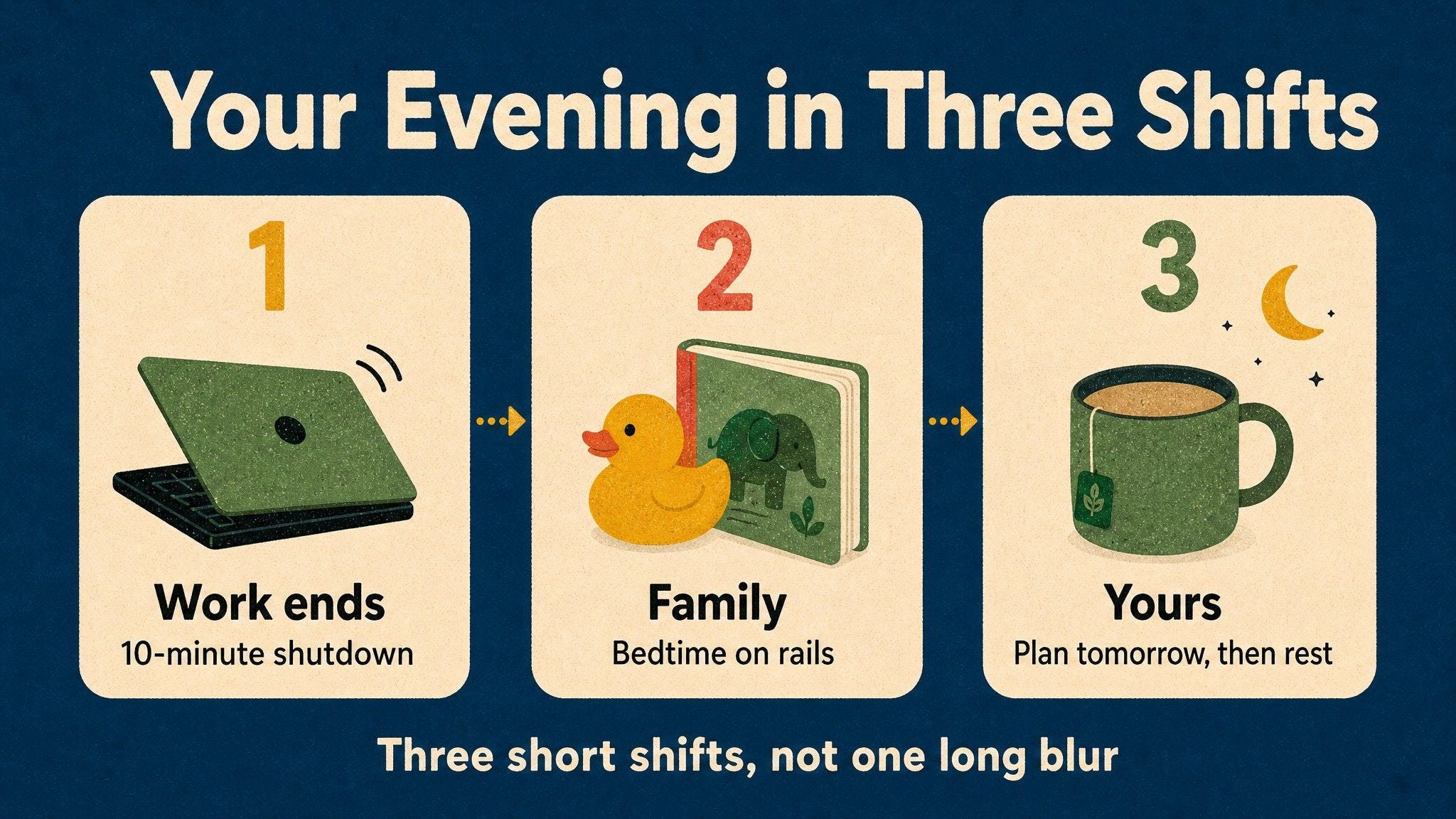
Here’s the reframe that changed things for me: your evening isn’t one long stretch of time — it’s three short shifts. There’s the shift where work ends, the shift where the kids get to bed, and the shift that’s yours. Most of us run them together, and that’s why the whole evening feels like a blur. Give each one a clear start and finish, and those dark November nights stop swallowing you whole.
Let’s go through how to do it.
1. Draw a Hard Line Under Work
The biggest thief of family evenings isn’t the kids. It’s the work you never quite finished.
If you work from home, the laptop stays open “just to check one thing”. If you commute, your head is still in the meeting you had at four. Either way, you walk into family time with half your brain somewhere else, and the kids can tell.
The fix is a ten-minute shutdown ritual at the same time every day:
Write down where you got to. One line per open piece of work, so you don’t have to hold it in your head overnight.
Pick tomorrow’s first task. Just one. It means tomorrow morning starts with a decision already made.
Close everything. Laptop shut, work notifications off, work phone in a drawer if you’ve got one.
Mark the transition. Change your clothes, go for a five-minute walk round the block, or stick the kettle on. Anything physical that tells your brain the working day is over.
That last step sounds a bit woolly, but it matters more in winter than at any other time of year. In summer, the light does the job for you. In November, 4pm and 9pm look exactly the same out of the window, so you need a signal of your own.
2. Make the First Hour Home Count
Here’s the uncomfortable truth about how to be present with kids after work: it’s not about the quantity of time. It’s about whether you’re actually there for the time you’ve got.
The hour between finishing work and dinner is usually the most chaotic of the day. It’s also the hour your kids most want you. So rather than trying to get things done in it, try protecting it:
Phone out of reach. Not on silent in your pocket. In another room. You’ll be amazed how often you reach for it out of habit.
Let them lead for fifteen minutes. Lego, a board game, a kick-about in the garden with a head torch. Fifteen minutes of their choice, with your full attention, buys a surprising amount of goodwill for the rest of the evening.
Do the boring jobs together. Laying the table, chopping vegetables, emptying the dishwasher. Kids are more willing helpers than we give them credit for, and it turns chores into time together rather than time away.
You don’t need a perfect hour. You need one where you’re not mentally in your inbox. That’s a lower bar than it sounds, and it’s the part your kids will actually remember.

3. Put Bedtime on Rails
Bedtime is where most evenings either hold together or fall apart. And the reason it falls apart is usually the same: every step is a negotiation.
Bath now or after the story? Which pyjamas? One more episode? Water, then a wee, then another water? Each decision is small, but stack fifteen of them together with tired children and you’ve got a recipe for a meltdown (theirs and yours).
The answer is a bedtime routine that runs on rails: the same steps, in the same order, at roughly the same time, every night.
Bath or wash
Pyjamas on
Teeth brushed
Bags and clothes ready for the morning
Story (a fixed number of books or chapters, agreed in advance)
Lights out
For younger kids, a picture chart on the bedroom door works brilliantly. They can see what comes next, and “what does the chart say?” settles far more arguments than “because I said so” ever will.
For older kids, give them ownership of their part. They set their own alarm, pack their own bag, and choose their own book. Your job shifts from doing bedtime to running it.
Two winter-specific tips:
Start the wind-down earlier than feels necessary. Dark evenings make everyone sleepier sooner, kids included. If bedtime regularly collapses, try starting the routine twenty minutes earlier for a week.
Dim the lights after dinner. Big overhead lights off, lamps on. It’s a cheap, easy cue that the day is ending, and it works on adults too.
4. Spend Ten Minutes on Tomorrow
Once the kids are down, there’s a strong pull towards the sofa. Resist it for just ten minutes, because the best morning routine starts the night before.
This is a mini version of the weekly planning session I’ve written about before, scaled down to a single day:
Check tomorrow’s calendar. School events, appointments, who’s doing pick-up. Nothing should ambush you at 7:45am.
Choose the one thing that matters most. Not a list of twelve. One task that, if it gets done, makes tomorrow a good day.
Rough out the day. What happens in the morning, what can wait until the afternoon, and what’s realistic for tomorrow evening.
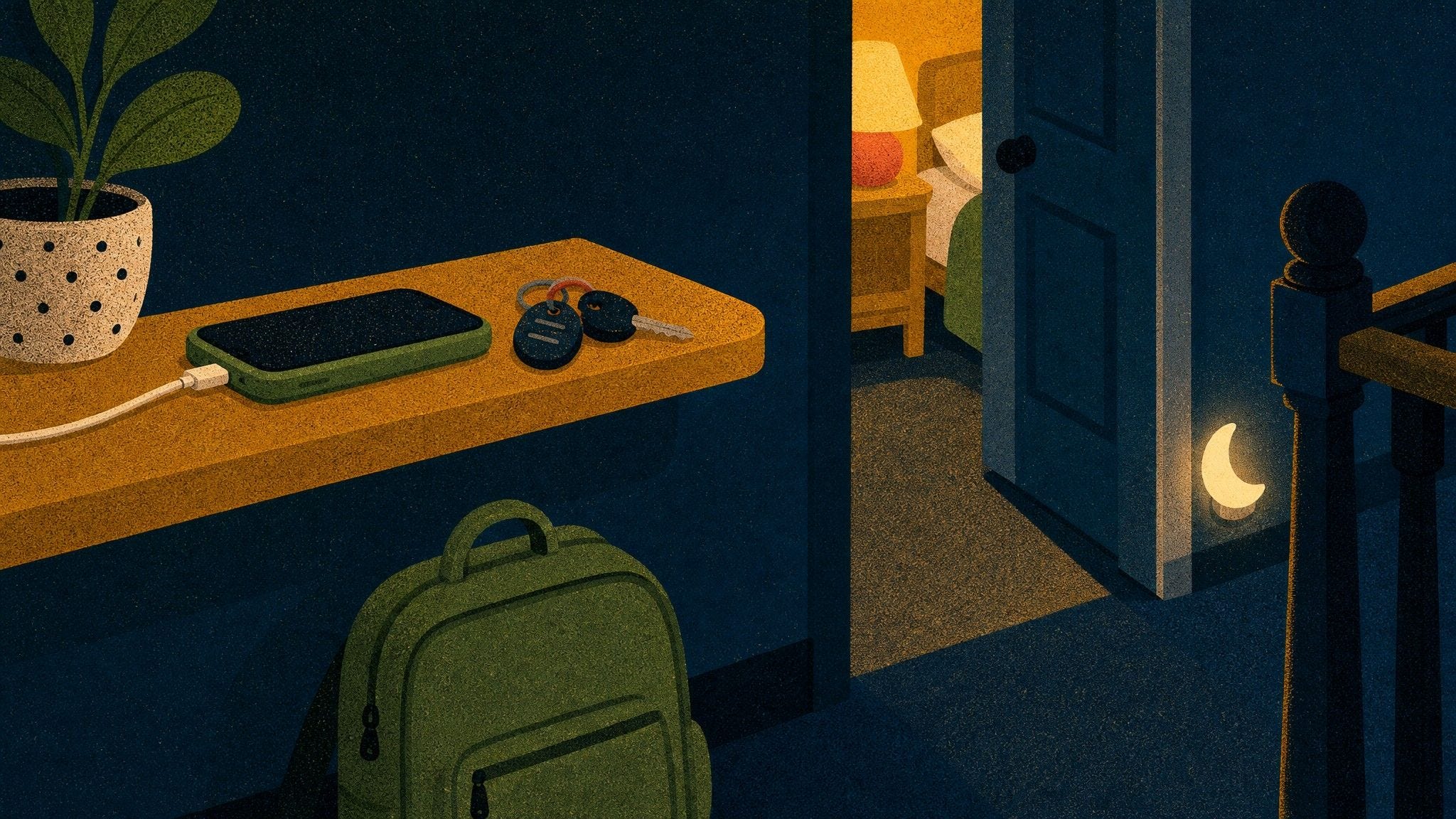
Get things ready for the morning. Bags by the door, lunches planned, car keys where they belong.
I do this in Do Everything. I tap tomorrow on the calendar, plan the day, and drop each task into a morning, afternoon or evening slot, with the one that matters most starred as the day’s highlight. A notebook on the kitchen side does exactly the same job, though. The tool matters far less than the habit.

Ten minutes tonight genuinely saves you thirty tomorrow. And it means you go to bed with a clear head instead of mentally rehearsing the to-do list at 2am.
5. Keep One Thing Just for You
Here’s where most evening routines for parents go wrong: they’re entirely about logistics. Shutdown, bedtime, prep for tomorrow. All useful, all necessary, and none of it is for you.
If every evening is spent servicing the next day, you’re running on empty, and that’s the road to burnout. So the third shift needs at least one thing that’s genuinely yours. A few options:
Something active. A run, a home workout, a swim. Dark evenings make outdoor exercise harder, so this might be the season for a few indoor sessions.
Something creative. A hobby you’ve let slide. Reading an actual book. Learning the guitar badly.
Something connected. Time with your partner that isn’t about logistics. A proper conversation, a film you both chose, a takeaway at the table instead of on your laps.
Something reflective. Three lines about how today went: one thing that went well, one that didn’t, one thing you’re grateful for. It takes two minutes and it’s oddly good at stopping the day from following you to bed.
The key is to decide in advance. If you leave it until 9pm, the default is always scrolling. If you’ve decided “Tuesday is a run, Wednesday is a film night”, it happens far more often.
6. Set a Bedtime for Yourself, Too
We’d never let our kids go to bed whenever they felt like it, but most of us do exactly that to ourselves. Then we wonder why the alarm feels like a personal attack.
Your evening routine should end with you going to bed at a sensible time. A few things that help:
Set a “start winding down” alarm thirty minutes before you want to be asleep. It’s the cue to put the phone away and head upstairs.
Charge your phone outside the bedroom. Buy a cheap alarm clock if you need to. This one change does more for your sleep than any app or supplement.
Protect it like you’d protect your kids’ bedtime. “Just one more episode” works on you too, and it’s a trap.
When Evenings Fall Apart (Because They Will)
Let’s be honest. Some nights, none of this happens. Someone’s ill. Work runs late. Your youngest decides that tonight is the night they will not, under any circumstances, get in the bath. You get to 9pm having done precisely nothing on this list.
That’s fine. The point of a routine isn’t to have a perfect evening every night. It’s to have a default to come back to.
A few things that help on the bad nights:
Keep a “minimum viable evening”. If everything goes wrong, what are the two things that still need to happen? For me, it’s the kids getting to bed and the bags going by the door. Everything else can slide.
Don’t try to catch up at 10pm. Working late to make up for a chaotic evening just borrows from tomorrow, at a terrible rate of interest.
Swap shifts with your partner. If one of you does bedtime, the other gets their third shift that night, then switch. Taking turns makes it sustainable for both of you.
And remember, the first couple of weeks after the clocks change are always rough. Everyone’s body clock is adjusting, the kids included. Give it time before you decide the routine isn’t working.
Start Small: Three Things for This Week
You don’t need to overhaul every evening at once. Pick one shift and get that working first.
If I had to choose three moves for this week:
Do the ten-minute work shutdown tomorrow. Write down where you got to, pick tomorrow’s first task, close the laptop.
Write the bedtime routine down. Six steps, same order every night. Stick it on the bedroom door.
Plan one evening that’s just yours. Pick the night, pick the thing, put it in the calendar.
That’s it. Three small changes, and the dark evenings start to feel less like something you survive and more like something you get to use.
Over to You
What does your evening look like right now: three neat shifts, or one long blur? And what’s the one thing that keeps derailing it? Tell me in the comments. I’d love to hear what works in your house.
If you found this useful, you might also enjoy The 30-Minute Weekly Planning Session Every Busy Dad Needs — the weekly version of the ten minutes in section 4 — and Dad Burnout Is Real, on why that third shift matters more than it looks.