

It’s 9:40pm on a Wednesday in early December. You’ve just sat down when your partner looks up from their phone and says, “It’s Christmas jumper day tomorrow. Did you know it’s Christmas jumper day tomorrow?” You didn’t. Neither of you did. And somewhere between the nativity costume, the teacher’s present, the work party and the cousins arriving on the 23rd, you realise that Christmas planning for dads has mostly meant waiting to be told what’s happening next.
If that sounds familiar, you’re not alone, and you’re not useless. December just works differently from the rest of the year.
Why December feels so much harder than it should
Here’s the thing I’ve noticed after a few Christmases as a dad: it isn’t the big day that wears you down. It’s the forty small jobs in the three weeks before it.
Each one is tiny. Buy a tea towel for the shepherd’s headdress. Send a fiver in for the class collection. Order the turkey before the slots go. Post the card to Auntie Sue in time. Remember that the after-school club finishes a week early.
None of them is hard. The problem is that nobody writes them down. They live in somebody’s head, and in a lot of households that somebody is one person. That’s the mental load: not doing the jobs, but noticing them, remembering them and deciding when they happen.
So the fix isn’t to try harder, or to wing it with more enthusiasm. It’s to get December out of everybody’s head and into one place you can both see. One list. Shared. With dates on the things that bite.
Here’s how I do it.
Step 1: Do a 20-minute December brain dump this weekend
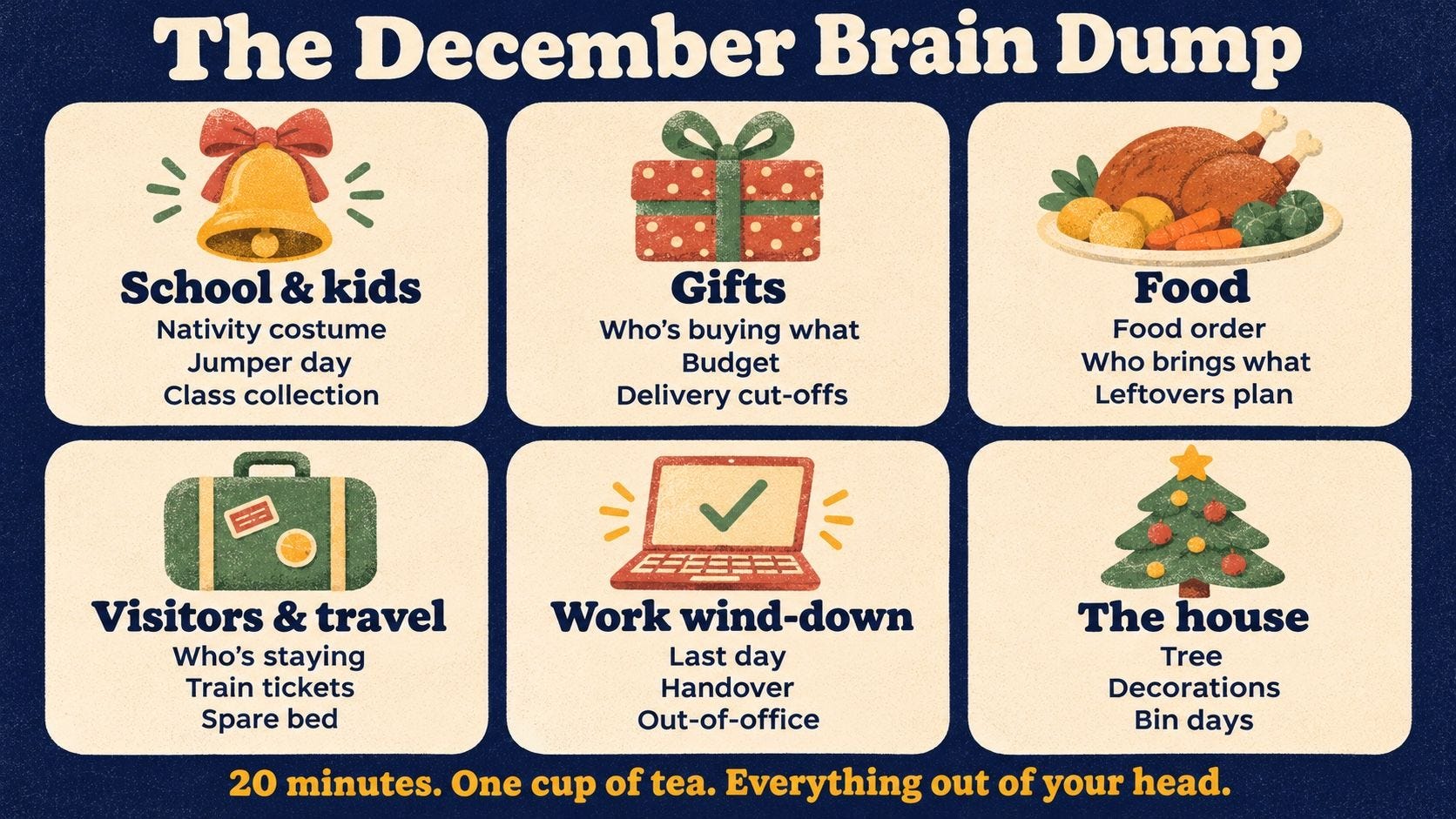
Before you organise anything, empty it out. Sit down with your partner (or on your own if you’re co-parenting or flying solo) for twenty minutes with a cup of tea, and write down everything December holds. Don’t sort it yet, and don’t judge it. Just get it out.
If you get stuck, walk through these six areas one at a time:
School and kids’ events: nativities, carol concerts, jumper days, last day of term, parties, costumes, class collections.
Gifts: who you’re buying for, who’s buying what, budgets, delivery cut-offs, wrapping.
Food: the big meal, the food order or delivery slot, who’s bringing what, the Boxing Day leftovers plan.
Visitors and travel: who’s coming when, who’s staying where, train tickets, the car boot that won’t fit everything.
Work wind-down: your last day, the handover, the out-of-office, anything that has to be finished before you stop.
The house: the tree, decorations, the spare bed, the bins on a changed collection day.
You’ll probably end up with thirty to fifty items. That’s normal. Seeing them all at once is a bit alarming, but it’s far less alarming than discovering them one at a time at 9:40pm.
Step 2: Turn it into one shared Christmas to-do list
A brain dump on the back of an envelope gets lost under the post by Tuesday. The next step is to put it somewhere you’ll both see it, every day, without having to ask.
What matters is that it’s:
Shared: both parents can see it, add to it and tick things off. If only one of you can see the list, the mental load hasn’t moved anywhere.
Split into sections: the six areas from your brain dump work well, so you can see at a glance how gifts are going without wading through food.
On your phones: December jobs pop up at the school gate and in the supermarket queue, not at your desk.
You can do this with a shared note, a family calendar or whatever app you already use. I use Do Everything for ours: a shared “December” list with a section for each area, which my partner and I both have on our phones. When one of us adds “buy batteries for the thing”, the other sees it too, so nobody has to be the one who remembers.

The magic isn’t the app. It’s the moment you stop saying “did you remember to…?” and start saying “it’s on the list”.
Step 3: Put dates on the jobs that bite
Most of December’s jobs can happen any time in the next three weeks. A few can’t, and those are the ones that ruin an evening if you miss them.
Go through your list and add a date to anything with a hard deadline:
School events: get the dates from the school newsletter now, while you’re thinking about it, not the night before.
Delivery cut-offs: most online shops publish their last order date for Christmas delivery. Look them up for the two or three shops you’ll actually use.
Last posting dates: Royal Mail publishes them every year. If you’re sending anything abroad, it’s earlier than you think.
Food orders: supermarket Christmas delivery slots often open, and fill, weeks before the big day.
Your last day at work: and the day before it, which is when the handover really happens.
Then work backwards. If the nativity is on the 12th, “sort costume” belongs on the 8th, not the 11th. A due date on the event is a reminder. A due date on the job before it is a plan.
This is the same trick as a good weekly planning session: you’re not trying to do everything now, just deciding when each thing happens so you can stop carrying it around.
Step 4: Split by ownership, not by task
Here’s where a lot of couples go wrong, and where us dads can make the biggest difference.
The usual split is task by task: “Can you pick up the wrapping paper?” That still leaves one person doing all the noticing, the remembering and the asking. You’re helping, but you’re helping someone else’s plan.
Instead, split by area. Each of you owns whole sections of the list, end to end:
“I’ve got school and kids’ events: the dates, the costumes, the collections, all of it.”
“You’ve got food: the order, the menu, who’s bringing what.”
“We’ll split gifts: I’ll do my side of the family, you do yours.”
Owning an area means you also own the noticing. If the school sends a letter about the carol concert, it’s yours to read, date and put on the list. Nobody has to remind you, because it’s your thing.
If you take one idea from this post, take this one. It’s the single biggest shift in how December feels in our house.
Step 5: Make a “not this year” list
Now for the bit that feels wrong but works: look at your list and cut a third of it.
Christmas collects traditions the way a kitchen drawer collects takeaway menus. Each one seemed lovely once. Together they turn December into a timetable.
Try this: everyone in the family picks the one thing that makes it feel like Christmas to them. For my kids it might be decorating the tree and the advent calendar. For your partner, maybe a particular film on Christmas Eve. For you, perhaps a long walk on Boxing Day. Those are protected.
Everything else is optional. Write down what’s not happening this year (the homemade cards, the third lot of visitors, the elaborate dessert nobody really eats) and move it to a “not this year” section at the bottom. It’s not cancelled forever. It’s just not happening this December, and seeing that written down is surprisingly freeing.

Step 6: Protect a few evenings that aren’t on the list at all
The point of all this organising isn’t a perfectly executed December. It’s having the headspace to actually enjoy it, and to be present with your kids rather than mentally running through the food order while they show you their nativity lines.
So once your list is in shape, block out some time that has nothing on it. Two or three evenings with no events, no wrapping and no admin. A Saturday morning with nowhere to be. If your November evening routine has slipped (mine always does by mid-December), this is a good moment to rescue one or two nights of it; I wrote about how in An Evening Routine for Dads.
Empty time won’t appear on its own in December. You have to put it there on purpose.
When things fall apart anyway
They will. It’s December, and you have children.
Someone will get a sickness bug on the morning of the carol concert. A present will be “out for delivery” until the 27th. You’ll find the costume letter in a book bag at 10pm. Here’s how I try to handle it:
Plan for one thing to go wrong each week. If you expect it, it’s an inconvenience, not a crisis. Leave a little slack in the list for it.
Have a “good enough” fallback for the big things. If the costume fails, a tea towel and a dressing gown make a shepherd. If the delivery fails, a voucher in a nice card is fine. Decide the fallbacks now, while you’re calm.
Check the list together once a week. Five minutes on a Sunday: what’s coming up, what’s slipped, who needs a hand. That’s all.
Let the “not this year” list grow. If the week gets away from you, move something else to it. That’s not failing at Christmas. That’s prioritising.
And if it all goes sideways and you end up with beans on toast on the 23rd because the food delivery didn’t come? Your kids will remember the beans on toast fondly. Probably for years.
Start small: three things to do this weekend
You don’t need to overhaul your whole December by Monday. Just:
Do the 20-minute brain dump with your partner, using the six areas above.
Put it in one shared list with a section per area, on both your phones.
Pick your areas. Say out loud which sections you own, and add dates to the three jobs most likely to catch you out.
That’s it. The rest of December gets a lot quieter once it’s all in one place.
What’s the December job that always catches you out? Tell me in the comments. I’d love to hear I’m not the only one who finds out about jumper day the night before.
More from Dads Getting Stuff Done: